
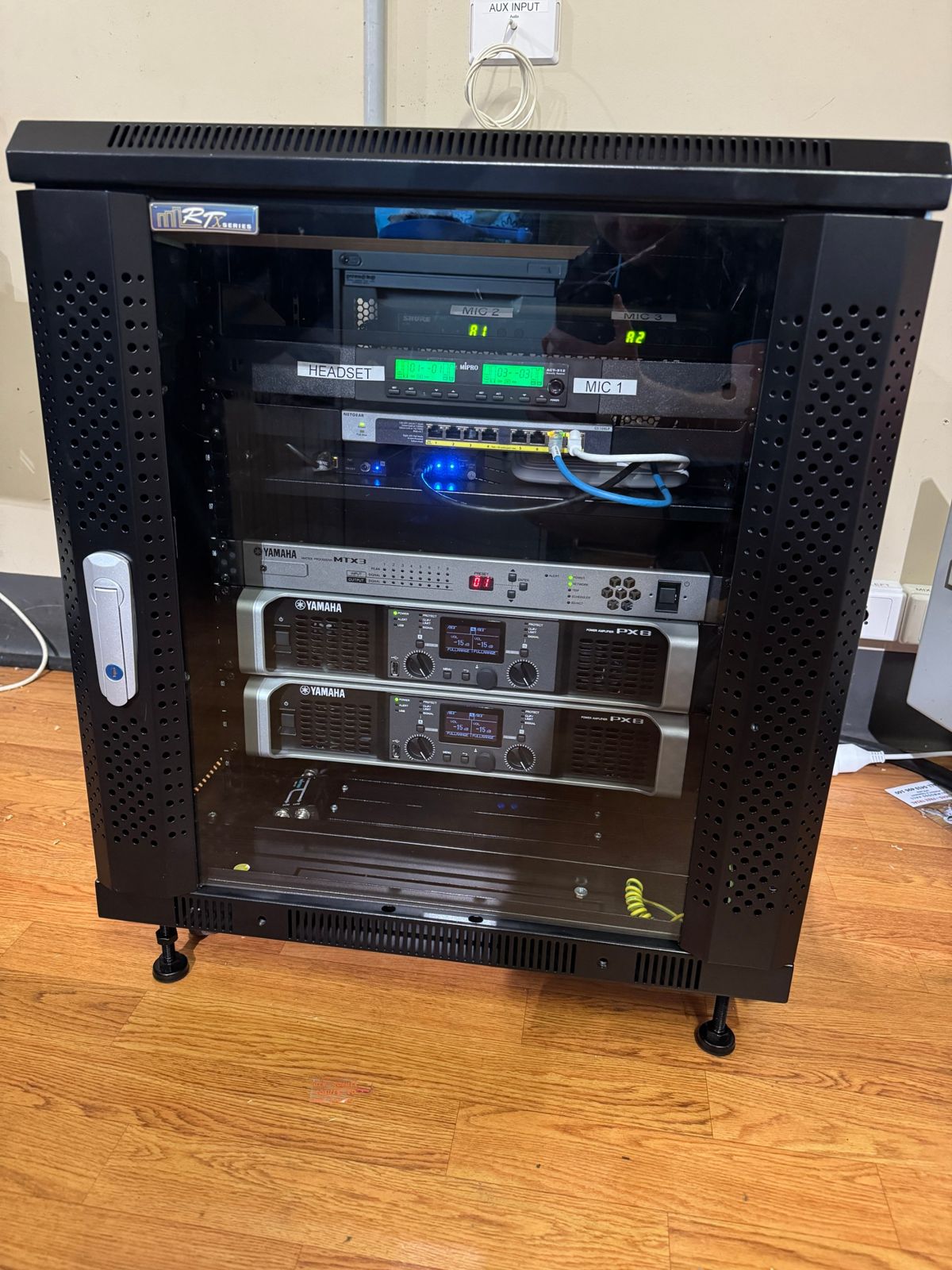
School Sound System Buyer’s Guide
For business managers, IT managers and facilities staff planning a new sound system, a hall upgrade or better outdoor coverage.
Sound is where most school systems fall short. It’s rarely because the equipment is wrong. It’s usually because the scope was drawn too narrowly at the planning stage. A system that covers the assembly hall from the lectern won’t reach the sports field. A wireless microphone setup that works for one MC won’t cope with a whole-school sports day and four announcers. And a portable speaker that suits the drama department will sound underpowered at a formal.
This guide walks through what a school sound system needs to cover, how to plan each part and what to budget. It’s written for schools across South-East Queensland, Regional and Remote Queensland, and Northern NSW. School sound is one of our specialties, and we install established commercial-grade equipment built for daily school use.
What does a school sound system need to cover?
A working school sound system usually has to handle four different situations. You can design for all four from the start, or design for one and add the rest later, usually at a higher cost.
1. Assemblies
Clear speech from the lectern to the back row, at a comfortable listening level. Support for music playback, video sound and several wireless microphones for the MC, guest speakers and awards presenters.
2. School-wide announcements
Daily announcements and bells across classrooms, corridors and outdoor areas are handled by a separate, school-wide PA and bell system, not the hall system. It’s a different specialty and not something we install, but it’s worth knowing where it starts and stops, so the two don’t get mixed up in a scope.
3. Outdoor and sports coverage
Sports days, cross-country, outdoor assemblies and carnivals. Weatherproof speakers covering fields and courts, with several wireless microphones for commentators and MCs.
4. Formal events
Graduations, awards nights, drama and music performances, and community events. Higher expectations, more microphones and tighter timing, often with recorded music and video sound cues.
A plan that only covers assemblies is really only planned for the first of these, and will need revisiting for the other three.
Speaker placement basics
As a rule of thumb, we allow roughly one main speaker for every 60 to 80 square metres of hall floor for even coverage, and add delay speakers once a hall is deeper than about 25 metres. Typical layouts look like this:
- Small hall (100 to 200 seats): two main speakers, one either side of the stage.
- Mid-size hall (200 to 500 seats): two main speakers plus two delay speakers halfway down the hall, with an optional subwoofer.
- Large hall (500 to 1,000 seats): two main speaker arrays plus two to four delay speakers, a subwoofer as standard, and front-fill speakers for the first few rows.
Column speakers are common in Australian school halls because they spread sound evenly across a long, rectangular room and avoid the hot spots you get from a single pair of box speakers.
Outdoors, we use weatherproof horn speakers, rated column speakers or wide-coverage sports speakers. Typical layouts are:
- Sports oval: four to eight weather-rated speakers on light poles or a purpose-built tower, powered from a fixed amplifier rack.
- Covered outdoor learning area (COLA): two to four column speakers under the roof line.
- Portable outdoor: a battery-powered speaker system with wireless microphones, set up for one-off events.
A fixed outdoor system costs more upfront, but it saves someone setting up and packing down for every event.
Wireless microphones: how many, and which power option?
Plan for your biggest realistic event, not your average one. These are typical starting points:
| School size | Handheld microphones | Headset or lapel | Total wireless channels |
|---|---|---|---|
| Small primary | 2 | 1 | 3 |
| Mid-size primary | 4 | 2 | 6 |
| Secondary (500 to 1,000 students) | 6 | 4 | 10 |
| Large secondary or P–12 | 8+ | 6+ | 14+ |
Handheld microphones suit MCs, guest speakers and awards presenters. Headset and lapel microphones suit drama and dance, PE teachers running sports days, and anyone who needs their hands free.
- AA battery systems: lower upfront cost but higher running cost, often 10 to 15 battery changes a week when they’re in regular use. Easy to swap on the fly.
- Rechargeable systems with a docking station: higher upfront cost and almost no running cost. They charge overnight, and the battery packs need replacing every three to five years.
For schools with eight or more wireless channels in weekly use, a rechargeable system usually pays for itself within 18 to 24 months on batteries alone.
Connecting your sound system to the LED wall
Halls with an LED video wall should send the wall’s audio through the main sound system, not through the screen’s own speakers. Built-in screen speakers are small, face forward and are designed for meeting rooms. Your hall system will cover the room far better.
Connecting the two usually involves:
- Audio travelling with the video from the laptop or source to the LED wall.
- A device at the wall that separates the audio and sends it to the sound processor.
- The processor mixing that audio into the main speakers alongside the microphones and music playback.
- Automatic ducking, so the video audio drops whenever someone speaks into a microphone.
Set up properly, a teacher plugs their laptop into the wall plate, the sound comes through the main speakers, and it automatically drops when they start talking. No mixing desk required.
Portable or fixed?
Some schools ask whether a portable system could serve the whole school. It rarely can, but portable systems are genuinely useful alongside a fixed install.
When a fixed system is the right call
- Weekly assemblies, where setting up every time quickly adds up.
- Multi-purpose halls used more than once a week.
- Any hall where the LED wall audio needs to come through the main speakers.
- Sports fields with regular events.
When a portable system is the right call
- Occasional events, once a term or less.
- Excursions and sports fixtures at other venues.
- Small drama groups and music practice.
- Backup while a fixed system is being serviced.
Most schools end up with a fixed system in the main hall, a fixed outdoor system on the main sports field, and one or two portable kits for excursions and off-site events, alongside the school-wide PA and bell system. That combination works well.
Indicative budget ranges
These ranges are in Australian dollars, excluding GST.
| Scope | Indicative range |
|---|---|
| Small hall sound (assemblies only, 2 main speakers, 2 handheld microphones, no outdoor) | $6,000 to $14,000 |
| Mid-size hall sound (2 main + 2 delay speakers, 4 wireless microphones, processor, LED wall integration) | $18,000 to $42,000 |
| Large hall sound (main arrays, delays, subwoofer, 8 wireless microphones, full processing) | $35,000 to $85,000 |
| Outdoor and sports field sound (4 to 8 weather-rated speakers, amplifier rack, 4 wireless microphones) | $18,000 to $55,000 |
| Portable sound kits (per kit, around 200 people) | $2,500 to $6,500 |
These assume standard cabling and mounting. Halls with acoustic problems, difficult ceiling access or long cable runs sit at the top of each range.
Common mistakes we see
These are the five mistakes we see again and again on school sound jobs.
1. Too few wireless microphones
Buying two wireless microphones for a school that runs weekly assemblies with an MC, a guest speaker and three awards presenters means constant microphone swapping, flat batteries and dropouts mid-speech. Plan for your biggest realistic event, not your average one.
2. Forgetting about outdoor coverage
The hall system covers the hall, but sports day happens outside. Borrowing the hall’s portable speaker for the oval means volunteers setting up for every carnival, and sound that’s thin at the boundary line. A fixed outdoor system pays for itself quickly for schools with regular outdoor events.
3. Home or hobby-grade equipment
Home speakers, consumer receivers and hobby mixers wear out early in schools. They’re used for longer, humidity is real, and they get handled a lot. Commercial-grade equipment is built for it.
4. No tuning to the room
A system that’s installed but not tuned to the room’s acoustics will sound average at best. Measuring and tuning the room is a two to four hour job at commissioning and makes a real difference, so make sure it’s in the scope.
5. Skipping the LED wall connection
A hall with a big LED wall and a separate sound system that doesn’t carry the wall’s audio means teachers plug in a laptop, get muffled sound from the small screen speakers and give up on the system. Connecting the two takes one to two days at commissioning and removes one of the biggest frustrations.
Frequently asked questions
What is a school sound system?
It’s the audio equipment that covers your assembly hall, outdoor areas and sports fields with clear speech and music playback. A complete setup usually includes a fixed hall system, an outdoor system for sports and events, and portable kits for excursions, alongside the school’s separate PA and bell system.
How much does a school sound system cost?
Indicative ranges, excluding GST: small hall $6,000 to $14,000; mid-size hall with wireless microphones and processing $18,000 to $42,000; large hall $35,000 to $85,000; outdoor and sports field $18,000 to $55,000; portable kits $2,500 to $6,500 each.
How many wireless microphones does a school need?
Typical counts are: small primary, 2 handhelds and 1 headset (3 channels); mid-size primary, 4 and 2 (6 channels); secondary, 6 and 4 (10 channels); large secondary or P–12, 8 or more handhelds and 6 or more headsets (14+ channels). Plan for your biggest realistic event, because swapping microphones mid-event is where things go wrong.
What speakers does a school hall need?
As a rule of thumb, roughly one main speaker for every 60 to 80 square metres of floor. A hall of 300 to 600 seats typically uses two main column speakers or arrays, two delay speakers halfway down if the hall is deeper than 25 metres, and an optional subwoofer for music.
Can we use a portable system instead of a fixed one?
Portable systems work well for occasional events, excursions and as a backup. They don’t suit weekly assemblies, LED wall audio or sports days. Most schools do best with a fixed hall system plus one or two portable kits.
Should the sound system connect to the LED wall?
Yes. Built-in screen speakers are designed for meeting rooms and sound thin in a hall. Sending the LED wall’s audio through the main sound system gives full coverage. It’s a one to two day commissioning task and makes a big difference to how teachers find the system day to day.
Are wireless microphones legal to use in Australian schools?
Yes, as long as they operate in the bands ACMA allows. Most professional systems use spare TV channels between 520 and 694 MHz under a class licence, so there’s no licence fee, but the channels that are free change from town to town. Older microphones that transmit between 694 and 820 MHz can no longer be used. We check which channels are clear at your site inspection.
What ongoing costs come with a school sound system?
Annual servicing ($1,000 to $3,000 for a mid-size school, covering microphone checks, tuning and a system health check), replacement batteries or charging packs every three to five years, and the occasional speaker or amplifier repair. Building servicing in from year one helps catch faults before they interrupt an event, and our service level agreements can cover it.
How long does a school sound install take?
For a straightforward hall upgrade with existing cabling, two to four weeks from purchase order to commissioning. New builds, or halls that need structural mounting or new cable runs, add four to eight weeks. Outdoor installs vary with trenching, poles and power. School holidays are the preferred install window. If an LED wall is part of the same project, allow for its delivery time too: LED walls are made to order and can take 10 to 12 weeks to arrive from the manufacturer.
Does a school hall sound system need hearing augmentation?
Usually, yes. The National Construction Code calls for hearing augmentation in halls with a built-in sound system, so students, staff and visitors who use hearing aids or cochlear implants can follow along. We integrate it with the hall sound system as part of the same install, so allow for it in your budget from the start.
Talk to Team LED
One team handles the whole job, from design to commissioning. Tell us about your venue and we’ll take it from there.